ADMM-MCBF-LCA: A Layered Control Architecture for Safe Real-Time Navigation

We consider the problem of safe real-time navigation of a robot in a dynamic environment with moving obstacles of arbitrary smooth geometries and input saturation constraints. We assume that the robot detects and models nearby obstacle boundaries with a short-range sensor and that this detection is error-free. This problem presents three main challenges: i) input constraints, ii) safety, and iii) real-time computation. To tackle all three challenges, we present a layered control architecture (LCA) consisting of an offline path library generation layer, and an online path selection and safety layer. To overcome the limitations of reactive methods, our offline path library consists of feasible controllers, feedback gains, and reference trajectories. To handle computational burden and safety, we solve online path selection and generate safe inputs that run at 100 Hz. Through simulations on Gazebo and Fetch hardware in an indoor environment, we evaluate our approach against baselines that are layered, end-to-end, or reactive. Our experiments demonstrate that among all algorithms, only our proposed LCA is able to complete tasks such as reaching a goal, safely.

IEEE International Conference on Robotics and Automation (ICRA) 2025
Proactive Local-Minima-Free Robot Navigation: Blending Motion Prediction with Safe Control

This work addresses the challenge of safe and efficient mobile robot navigation in complex dynamic environments with concave moving obstacles. Reactive safe controllers like Control Barrier Functions (CBFs) design obstacle avoidance strategies based only on the current states of the obstacles, risking future collisions. To alleviate this problem, we use Gaussian processes to learn barrier functions online from multimodal motion predictions of obstacles generated by neural networks trained with energy-based learning. The learned barrier functions are then fed into quadratic programs using modulated CBFs (MCBFs), a local-minimum-free version of CBFs, to achieve safe and efficient navigation. The proposed framework makes two key contributions. First, it develops a prediction-to-barrier function online learning pipeline. Second, it introduces an autonomous parameter tuning algorithm that adapts MCBFs to deforming, prediction-based barrier functions. The framework is evaluated in both simulations and real-world experiments, consistently outperforming baselines and demonstrating superior safety and efficiency in crowded dynamic environments.

Under Review
Towards Feasible Dynamic Grasping: Leveraging Gaussian Process Distance Field, SE(3) Equivariance and Riemannian Mixture Models

This paper introduces a novel approach to improve robotic grasping in dynamic environments by integrating Gaussian Process Distance Fields (GPDF), SE(3) equivariant networks, and Riemannian Mixture Models. The aim is to enable robots to grasp moving objects effectively. Our approach comprises three main components: object shape reconstruction, grasp sampling, and implicit grasp pose selection. GPDF accurately models the shape of objects, which is essential for precise grasp planning. SE(3) equivariance ensures that the sampled grasp poses are equivariant to the object's pose changes, enhancing robustness in dynamic scenarios. Riemannian Gaussian Mixture Models are employed to assess reachability, providing a feasible and adaptable grasping strategies. Feasible grasp poses are targeted by novel task or joint space reactive controllers formulated using Gaussian Mixture Models and Gaussian Processes. This method resolves the challenge of discrete grasp pose selection, enabling smoother grasping execution. Experimental validation confirms the effectiveness of our approach in generating feasible grasp poses and achieving successful grasps in dynamic environments. By integrating these advanced techniques, we present a promising solution for enhancing robotic grasping capabilities in real-world scenarios.

IEEE International Conference on Robotics and Automation (ICRA) 2024

No Minima, No Collisions: Combining Modulation and Control Barrier Function Strategies for Feasible Dynamic Collision Avoidance

Department of Mechanical Engineering and Applied Mechanics, University of Pennsylvania
Under Review

We validate the proposed MCBF-QP controllers in simulated hospital settings and in real-world experiments on fully actuated Ridgeback robots and underactuated Fetch platforms. Across all evaluations, Modulated CBF-QPs consistently outperform standard CBF-QPs.

Abstract

Control Barrier Function Quadratic Programs (CBF-QPs) are central to reactive safety-critical control due to their applicability to general control-affine systems and their ability to enforce constraints through optimization. Yet, they often introduce spurious local equilibria that hinder convergence to task goals. In contrast, Modulation of Dynamical Systems (Mod-DS) methods (including normal, reference, and on-manifold variants) geometrically reshape nominal vector fields to achieve obstacle avoidance with few or no local minima, but they lack a principled mechanism for enforcing input constraints and are typically limited to fully actuated systems. Revisiting the theoretical foundations of both approaches showed that, despite their seemingly different constructions, the normal Mod-DS is a special case of the CBF-QP, and the reference Mod-DS is linked to the CBF-QP through a single equation. These connections motivate our Modulated CBF-QP (MCBF-QP) framework, which introduces reference and on-manifold modulation variants that reduce or fully eliminate the spurious equilibria inherent to CBF-QPs for general control-affine systems operating in dynamic, cluttered environments.

Hospital: Fully Actuated

Video 1: Reference MCBF-QP Demonstration against CBF-QP and reference Mod-DS

Video 2: on-Manifold MCBF-QP Demonstration against CBF-QP and on-Manifold Mod-DS

Hospital: Underactuated

Video 1: Shifted on-Manifold MCBF-QP Demonstration against Shifted CBF-QP

Video 2: Augumented on-Manifold MCBF-QP Demonstration against Augmented CBF-QP

Social Navigation

Social navigation performance comparison
Figure 1. Comparison of Shifted MCBF-QP, Shifted CBF-QP, and MPC-CBF (horizon = 20) in a challenging dynamic social navigation task. Blue contours in the first-column images indicate the isosurface geodesically approximated to select the proper obstacle exit strategy \( \phi(x, \bar{h}) \) in MCBF-QP,shown by the red arrow.

Static Concave Obstacles

Video 1: Shifted CBF-QP

Video 2: Shifted on-Manifold MCBF-QP

Dynamic Adversarial Attacks

Video 1: Shifted CBF-QP

Video 2: Shifted on-Manifold MCBF-QP

Soical Navigation

Video 1: Shifted CBF-QP

Video 2: Shifted on-Manifold MCBF-QP

Mixed Environment

Video: Shifted on-Manifold MCBF-QP Demonstration through 5-Trial Validation

Results Summary
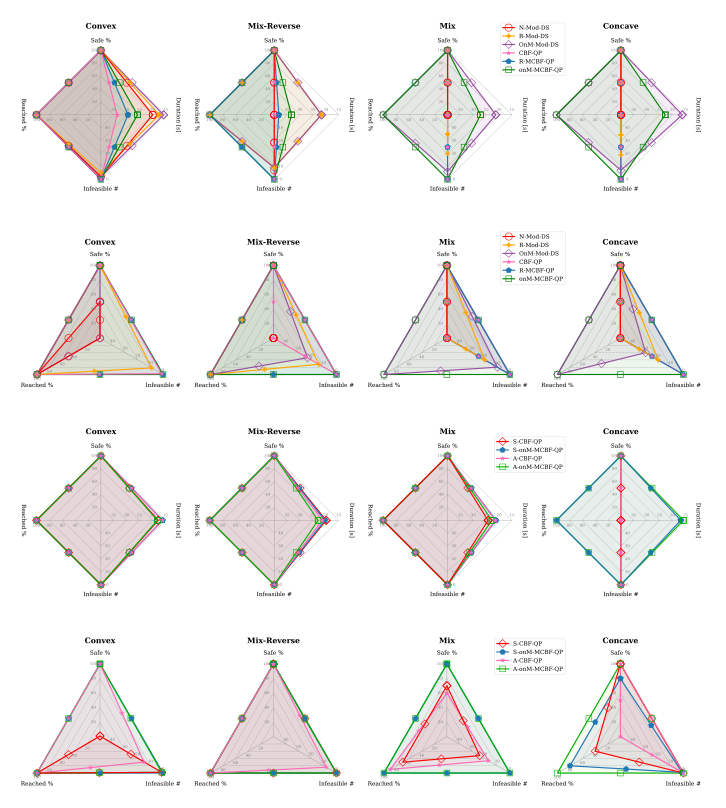
table
Figure 2. Spider plot summarizing controller performance in hospital navigation at 20~Hz. Metrics include average travel duration, Safe %, Reached %, and average number of infeasible QP instances per trajectory. Values are normalized between the center and outermost layer, where a larger radial extent denotes better performance.

BibTeX

@misc{xue2026minimacollisionscombiningmodulation,
      title={No Minima, No Collisions: Combining Modulation and Control Barrier Function Strategies for Feasible Dynamic Collision Avoidance}, 
      author={Yifan Xue and Nadia Figueroa},
      year={2026},
      eprint={2502.14238},
      archivePrefix={arXiv},
      primaryClass={cs.RO},
      url={https://arxiv.org/abs/2502.14238},
    }